
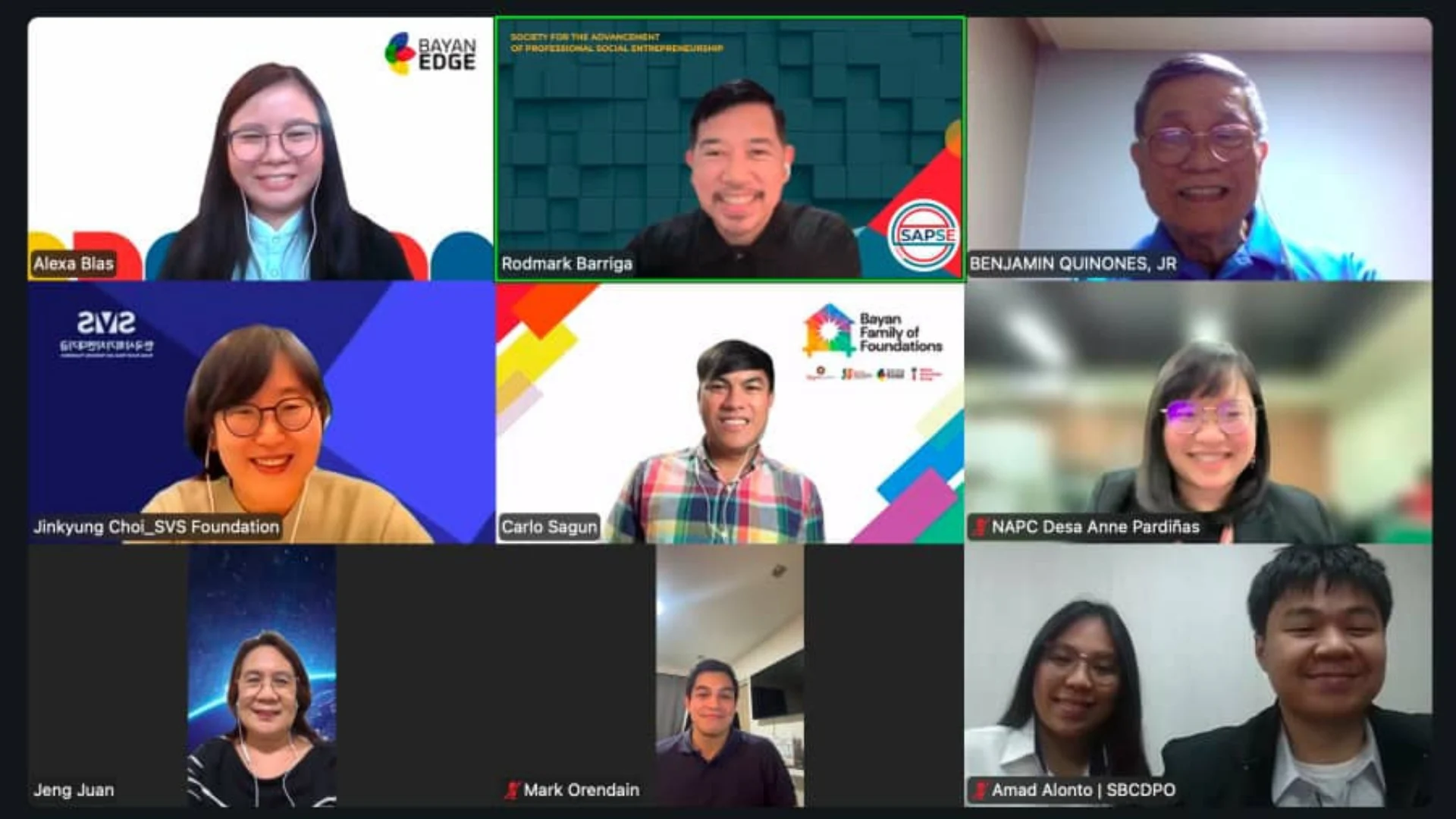
On December 9, 2025 there was an online conversation between the Koreans and Filipinos on Social Impact Bonds (SIB). The discussion was moderated by Dr. Benjamin Quiñones, Jr. Founder, Asian Solidarity Economy Council (ASEC). The speaker was Ms. Jinkyung Choi, Senior Program Manager, International Relations. Korea Social Value and Solidarity Foundation (SVF).
Part 1 – An Introduction to the Korea Social Impact Bond (SIB) By Ms.Jinkyung Choi
The Korea Social Value and Solidarity Foundation (SVF)
The Korea Social Value and Solidarity Foundation (SVF) is a private foundation. It raises funds from the Korean commercial banks, and social economy organizations such as credit unions and consumer cooperatives. Now, we’re taking our second chance to secure government funds from this new government. We’ve been busy in reframing the social finance initiatives in Korea. The ecosytem of the social enterprise in Korea is entering its 20th year. We are now graduating from the incubating phase to the growth phase. We need a supporting financial system to boost the growth of the social and solidarity economy (SSE) in Korea.
Laws in Korea on Social Impact Bonds
There were some discussions to adopt a law on SIB in Korea, but they were not able to adopt it because of lack of understanding and support of the public. The local government moved faster than the national government in adopting an ordinance to provide a regulatory framework for municipal SIBs. The first local ordinance on SIB was issued by the Seoul Metropolitan Government (SMG) in 2014. From thereon until 2022, 18 more local governments adopted ordinances on SIB until 2022. These local governments were able to follow easily the example set by the SMG because the Ministry of Administration and Security created a standard SIB ordinance form which local governments could promptly use.
The first SIB project was initiated by the SMG in 2016. It was intended to support children with borderline intelligence who have difficulties learning in the formal school. SIB is considered under the financial law in Korea either as investment contract or derivative-linked securities (DLS) which is linked to the social value as an index.
So far, we have only six cases of SIBs: 2 are from Seoul city, 1 in Chonggi province, 1 in Buyeo city, and 1 in Hwaseong city. Five of the six SIBs are outcome-based investment contracts with the local government, and the sixth is a bond that sources funds from private investors.
Stakeholders Involved in the SIB
The projects commissioned by the local government are confined within their respective administrative districts/regions. The government only pays for results, not just activities. To cite an example, the local government of Geonggi designed its basic livelihood support project, with the aim of providing microloans to the target group/beneficiaries, offering job training, and extending child care services to the families of the beneficiaries.
On the other hand, the one SIB project commissioned by private venture companies (e.g. the Social Innovation Finance, and the Pan-Impact Korea) had a nationwide coverage and aimed at mitigating the depression of the youth. They use online solutions to check the mental health of the youth beneficiaries, and minimize the incidence of suicide among them. Private investors take the initial financial risk, making it a form of Pay for Success (PFS) or Results-Based Financing (RBF).
The users of the funds are called “service providers” who provide solutions to achieve the project goal. They are usually a consortium of social enterprises or NGOs working at the local level. They undertake a number of interventions in various aspects because the projects are dealing with complex social issues. In countries like UK, sometimes the project manager is also the service provider. In which case the service provider participates in designing the project and they also manage the implementation of the project.
Evaluating the Success of the Project
You need an indicator to evaluate the success or failure of the project. In most of the cases, the indicators are specific and not too many. Like in the case of the Geonggi project which deals with the beneficiaries of the national basic livelihood program, the indicator was the percentage of project participants whose status have improved much better than the status of the national program beneficiaries. The goal of the service providers or implementors was to raise the status of the project participants over and above the status of the national program beneficiaries, and they have to undertake several interventions to achieve this.
Strengths and Weaknesses of the Korea SiB
The most important strength is that the Korea local governments were able to create ordinances to fit their development projects. The ordinance on SIB enabled them to move on. Among the 6 projects, 3 are already finished with very successful outcomes. But still we have difficulties of expanding this model to other local governments or other national programs particularly because we don’t have an overarching law that would allow local governments, for instance, to give tax incentives to investors.
The local governments that pioneered on SIB in Korea started with strong political initiative. The local political leaders pursued it because they had interest in it. But the more strategic civil servants at the policymaking level felt it was very hard to understand the operational process for implementing the SIB. It was new to them, they needed a new ordinance to make it work. The implementing process was the most challenging part for us in Korea. We believe this is the main reason why the number of SIBs in Korea did not increase rapidly.
Another factor that slowed down the adoption of the SIB by the local governments is the political change we went through in the last 3 to 5 years. That was really an awful period for the social sector. But things have changed for the better with the new government. New groups are coming back with new terms of outcome-based contract or outcome-based funding. We will have the local elections next year, and there is hope that some local leaders will bring back the policy measures on outcome-based funding. Our only concern now is that it’s not spreading out with the speed we wished in the beginning.
Another obstacle that the local government had to hurdle was budget allocation for the SIB project. The budget year for most programs in Korea is one-year period. This makes it difficult for a multi-year program like SIBs to fit into the government’s budgetary framework. So, the local ordinance for the SIBs has to define it as a multi-year project.
By nature, it takes around 6 months to one year to design one SIB project and attract the investors. For private sector projects, the implementing organization has to carry out the project with no funding support of the local government. They have to attract investors for the SIB in order to generate funds for the project. So, when you design your own SIB in the Philippines, you have to ensure that there are investors willing to place their funds in the social impact bond.
Usually in the contract, the local government has the responsibility to oversee the service provider. In reality, however, the local government cannot truly oversee the specific steps of the program. Owing to these peculiarities, it is important to have an ordinance that defines how different this program is from other procurement contracts of the local government.
As regards the returns to private investors, the first investors took the risk and several did not receive any incentives in the beginning. In later years, investors of the successful SIBs recovered their capital as well as financial return based on their achievement of the project targets, which actually ranged from 13 to 15 percent of the principal sum. So, it’s not really that bad compared to other investments. The first SIB was considered a derivative-linked securities (DLS). The commercial banks were not allowed to join as investors, due to our financial laws. That’s one thing we need to modify a bit. This is one reason we need an overarching law, so it can supplement our existing financial laws with appropriate provisions on the SIB.
Regarding ‘honest’ expected risks, there is a line in the contract which stipulates that in the event of natural disaster, the issuer may not be able to return the money to the investors at maturity date. However, since the contract is based on very specific target number, e.g. percentage of number of persons benefited by the program, as long as the program can be implemented and beneficiaries can participate, the investment is still good, although the investors may have to wait for a while to recover their investments. On this consideration, investment in SIB is considered less risky compared to other type of investments.
Part 2 – Potential for the Adoption of SIB in the Philippines
Jinkyung Choi: In view of our experience, what I’d like to recommend to you [Philippine stakeholders] is to make the “control tower “of the SIB project at the higher level of the local government inasmuch as several departments of the local government will be involved to achieve the project goal. In the case of Korea, up to two departments of the local government were involved in the SIB project. It was extremely difficult for the “SIB team” to go about persuading various concerned departments to approve the project. Even in their own department, the “SIB team” had to persuade their own staff. And worse, when the staff of the concerned departments have understood the value and implementing process of the project, they could be transferred to another department as required in the Korean administrative system. In which case, the “SIB team” may have to do again the whole process of promoting the SIB project to the new staff of the concerned departments. Therefore, it is advisable that the “control tower” of the SIB project should be an inter-department agency in the local government which can go through the project process more smoothly.
Ben Quinones: How can we carry on with this dialogue at the Philippine level with NAPC, APPEND Inc, Bayan Family of Foundations, Quezon City Small Business and Cooperative Development Promotion Office, the Rural Bankers Association of the Philippines so that we can continue to share our own ideas on creating SIBs in the country for the financing of social enterprises and social and solidarity economy (SSE) entities?
Carlo Sagun: As far as conceptualization and exchange of ideas on the application of SIB in the Philippines is concerned, let’s get the thing going as early as third week of December 2025, before we go on a break so that our thoughts can simmer throughout the break. We can host it in the BFF office. In January 2026, we can hold a follow up meeting to include other potential stakeholders, such as the Rural Bankers Association of the Philippines.
Desa Ann Pardeñas: I can definitely say that NAPC is one of the important stakeholders when it comes to SIB in the Philippines. As you might already know, NAPC is a national government agency mandated to oversee the operationalization of PDTF (People’s Development Trust Fund). Unfortunately, out of the PhP4.5 Billion PDTF funds, only PhP100 Million is operationalized. Hopefully, we’ll see bigger fund flows next year (2026). NAPC is mandated to coordinate 14 basic sectors involved in implementing the Philippine Social Development Agenda. It is not an implementing agency, so I would like to know how NAPC could participate and help in this initiative.
Jinkyung Choi: In Korea, there are certain Ministries that are interested in similar kind of initiative, like the Ministry of Welfare. They would like to make an investment program for social enterprises that actually have the solutions for reducing the social issues. They have been looking at an investment fund since 2-3 years ago. But, they’re going through a difficult process of making agreement with stakeholders. There are also other ministries that are working with us and with social enterprises.
Jeng Juan, APPEND Inc. There is one microfinance NGO in the Philippines, the ASA Philippines Foundation, that has issued a bond. They were able to raise Php 5.0 billion. They called it the “Green Bond”. The income from the bond is being used to fund the microfinance loans of ASA Philippines clients. It was supported by Bangko Sentral ng Pilipinas and Asian Development Bank. The intermediaries were BDO Capital Investment and Landbank. we can look at it as a live model, and study it. We’re excited to have an SIB in the Philippines that will cater to not just one sector but all sectors that need funding.
Carlo Sagun: The BFF has developed a sector-led nationwide initiative for us to be able to gather the efforts of the sector stakeholders without actually needing a law for us to be able to move. We are also part of the task force forming the Global Steering Group for Impact Investment (GSGI) national partner in the Philippines.
As regards preliminary work on the SIB, we have already done the study on the set-up costs of the financing platform and gathered stakeholders from various sectors in the past three years. We have funded the mobilization and knowledge/ experience sharing among all stakeholders throughout the country. We already have a nationwide mechanism for the comprehensive development of social enterprises, a strength we can collectively consider. In Korea, social impact bonds ordinance and the issuance of the SIBs in specific cases is definitely a strength on their end. From our end, the orchestration of sector-led stakeholders that would need the bond came first.
At the first instance, we may want to keep the introduction of SIB low key, without calling it a bond at first. But in terms of concept and how it is benefiting the right stakeholders we can enter into certain institutional contract with select actors and probably use that as a means for us to frame a semblance of an initial outcome from a small pilot project. We can use the pilot outcome to mobilize other stakeholders to come along.
NAPC has been present throughout. When we talked with Secretary Lope Santos during the Philippine Social Enterprise Roadmap Conference (November 5-7, 2025), he mentioned the possibility of sourcing the PhP4.00 billion in the trust fund as early as next year. Given that BFF has already invested three years of work in mobilizing stakeholders throughout the country, by all means NAPC could use BFF for NAPC’S need to finance programs intended to reduce poverty index in the country.
To the extent that the NAPC trust fund can be used to provide a social impact guarantee, the the Rural Bankers Association of the Philippines (RBAP) might be persuaded to come on board and mobilize investments from its member banks. An alternative source for guarantee fund is the SDG Fund that’s in DEPDev (Department of Economy, Planning, and Development, formerly NEDA). It actually amounts to 20 percent of all the sin taxes collected year on year. That’s a huge amount. In 2025 alone, it amounted to PhP 25 billion. And they don’t have a clear mechanism yet for how it should deliver the SDGs. With NAPC’s intercession at the national level, it might also be possible to tap the DEPDev SDG fund to be used as a guarantee for investments in the SIB. That would be a huge step already.
Ben Quiñones: Based on the rules and regulations of the Bangko Sentral ng Pilipinas (BSP) municipal bonds are guaranteed by the local government unit (LGU) as the issuer of the bond. When the project goals are achieved, the LGU pays the investor. [1] One thing NAPC can do is to help persuade local government units (LGUs) participating in the government’s poverty alleviation program to issue their own social impact bonds. NAPC may also look into the possibility of working with the LGU Guarantee Corporation (LGUGC) regarding the provision of guarantee for LGU investments in SIB.[2]
On another matter, Dominique Lessafre, a member of the GSEF Advisory Committee, thought of inviting the Social Enterprise Financing Platform (SEFP) to become a member of GSEF. However, the SEFP is not an organization but a platform or program, so it may not qualify to be an institutional member of GSEF. An alternative step is level up the dialogue on SIB to the global level with the help of GSEF. SIB is a new thing for us, we need information, technical advice, technical assistance from impact investors, experts, and managers of SIBs in other countries. This will enrich tremendously the dialogue on SIB between Korea and the Philippines. What do you think about this idea?
Jinkyung Choi: Our SIBs also need to develop a lot. We also need that kind of mutual learning from other countries. We are quite interested in the Japan case, they tried so many projects and also the Singapore case and other ASEAN countries who are now starting with very strong initiative. So, it would be great if there’s some kind of mutual learning about SIBs and we can share our experience.
There are not many experts on SIBs in Korea. As I’ve heard from my colleague who got his PhD on SIBs, he’s the third or fourth person who got his PhD on SIB. It’s quite a small pool of SIB experts who can consult on SIB. Korea is also at the very nascent stage of SIB compared to UK. From our research, there are about 220 SIB projects in the world, and every project has a very different structure, highly flexible form, and creative tool to create social values and to prove the social value of social enterprises, what social enterprises can actually do. While we have finished 3 projects with success, many commercial investors in Korea are not engaged in impact investing because they don’t consider it as real investing. Changing their awareness, their thoughts is another challenge for us. The SIB is not defined in the financial legal framework in Korea. It could be considered as a bond, or equity. There is no regulation, that means it can be regulated by anything, by any law..
We are also part of the Korean national partner of GSG Impact (GSGI). The participation of GSGI in the dialogue on SIB would be beneficial because they have experience on the SIBs. We can ask GSGI to initiate a learning curve on this specific theme. It would also be good to involve the Social Innovation Investment Foundation of Japan. They are collecting data on the whole impact ecosystem of Japan and SIB is a part of it. In Asia as a whole, there is no one dominant network that carries this agenda on SIB, so we might just gather the right partners and it could be a productive initiative.
Speaker:
Ms. Jinkyung Choi, Senior Program Manager, International Relations. Korea Social Value and Solidarity Foundation (SVF)
Moderator:
Dr. Benjamin Quiñones, Jr. Founder, Asian Solidarity Economy Council (ASEC)
Participants:
- Mr. Carlo Sagun, President and CEO, Bayan Family of Foundations (BFF)
- Mr. Rodmark Barriga, President, Society for the Advancement of Professional Social Entrepreneurship (SAPSE)
- Ms. Denna Anne Pardeñas, National Anti-Poverty Commission (NAPC)
- Ms. Alexa Blas, Executive Director, Bayan Edge
- Dr. Virginia “Jeng” Juan, President, APPEND Inc.
- Mr. Amad Alonto, Quezon City Small Business & Cooperative Development Promotion Office (QC-SBCDPO)
1 In the Philippines, LGU municipal bonds can be issued with or without a full guarantee from the National Government (NG), depending on the agreement and approvals, but they primarily rely on the LGU’s own creditworthiness and project revenues for repayment, with the NG stepping in only if the LGU defaults on a guaranteed bond. The LGU Guarantee Corporation (LGUGC) plays a role in guarantees, and the Department of Finance (DOF) and Bangko Sentral ng Pilipinas (BSP regulate these issuances, making it a mix of LGU commitment and potential national support.[See BSP Circular No. 44, s.1994, August 26, 1994. “Rules and regulations governing the issuance, placement, sale servicing, redemption and retirement of bonds issued by local government units”.
2 Executive Order No. 110 provides that the PDTF “shall be used to systematically provide funding for microfinance and micro-enterprise capability building with parallel efforts in providing a supportive and appropriate policy environment and institutional framework for a private-led micro-financial market”.