
By Ms Zoel Ng (MySDG Academy Malaysia)
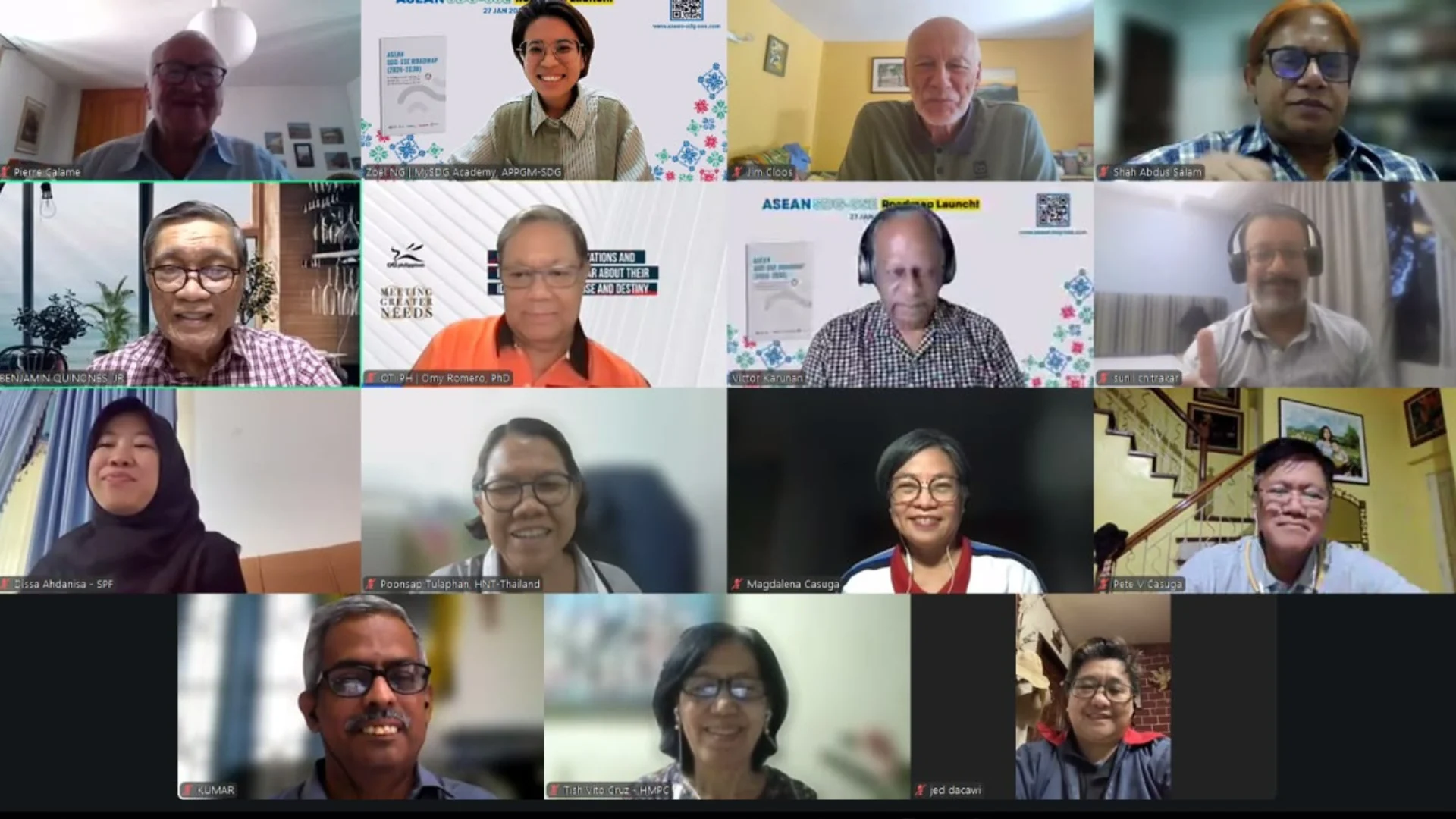
A virtually meeting was convened on 14 August 2026 for the Dialogue on the 21st Century Agenda, creating a cross-regional space to explore how emerging approaches to sustainable development, governance and the Social and Solidarity Economy (SSE) could contribute to addressing the complex challenges of the 21st century.
The dialogue brought together participants from Europe and across Asia, including representatives and practitioners working in academia, civil society, cooperatives, community development, social entrepreneurship, public policy and international development.
The programme opened with an introduction by Dr. Benjamin R. Quiñones Jr., Founding Chairperson of the Asian Solidarity Economy Council (ASEC), followed by Pierre Calame, who introduced his proposed 21st Century Agenda. Jim Cloos, former senior civil servant of the European Council and Secretary General of TEPSA, subsequently provided perspectives on the relevance of building stronger ASEAN–EU connections around the agenda.
From Global Ideas to Local Practice. A central focus of the dialogue was a practical question: How closely do existing sustainable development initiatives in Asia already reflect the principles envisioned in the 21st Century Agenda?
Five different approaches were presented: ASSEFA, Fair Trade, the Self-Help Group–Bank Linkage Programme, Social and Solidarity Economy, and the ASEAN SDG–SSE Roadmap 2026–2030. The presentations revealed substantial convergence.
Kumar Loganathan demonstrated how ASSEFA’s Gandhian-inspired community development model integrates economic development, ecological stewardship, community institutions and participatory governance. The analysis suggested that many principles proposed for future global governance are already being implemented from the bottom up through communities and local institutions.
Similarly, Dr. Sunil Chitrakar showed how Fair Trade translates values such as solidarity, responsibility, sustainability, participation and justice into practical economic relationships involving producers, consumers and markets. Fair Trade therefore provides an example of how a responsibility-based economy can operate within existing international trade systems.
Dr. Benjamin Quiñones examined the Self-Help Group–Bank Linkage Programme (SBLP), which connects low-income and rural communities with formal financial institutions. His assessment found strong alignment with nine of the eleven propositions examined, particularly in community empowerment, shared responsibility, participatory governance and multi-actor collaboration.
Social and Solidarity Economy as an Institutional Bridge. The discussion also highlighted the broader potential of Social and Solidarity Economy as a framework capable of connecting social, economic, ecological and governance objectives.
Presented by Ma. Patricia “Tish” Vito Cruz de Vera in collaboration with ASEC, the analysis positioned SSE as particularly comprehensive because it extends across cooperatives, social enterprises, community and solidarity finance, democratic ownership, participatory governance and territorial development.
This is significant because the transition towards sustainability cannot depend on government action or markets alone. It requires institutions capable of connecting communities, businesses, governments, civil society, finance and knowledge institutions around shared responsibility and common outcomes.
ASEAN SDG–SSE Roadmap: From Principles to Regional Action. This was presented by Dr. Victor Karunan and Zoel Ng, offered a Southeast Asian implementation perspective.
The comparative analysis found approximately 85–90% alignment with nine to ten of the eleven foundational propositions of the 21st Century Agenda. Both frameworks advocate movement away from narrowly market-centred development towards approaches that are more people-centred, ecological, collaborative and solidarity-based.
Importantly, their roles are complementary. While Calame’s framework provides a normative and conceptual architecture for societal transformation, the ASEAN SDG–SSE Roadmap provides an operational pathway for translating similar principles into regional cooperation, community empowerment and sustainable economic practices.
The Roadmap also promotes multi-stakeholder governance involving governments, SSE organisations, cooperatives, civil society, academia, financial institutions, development partners and local communities, reflecting the increasingly interconnected nature of sustainable development challenges.
Building a New ASEAN–EU Conversation. The dialogue concluded with discussion and a dedicated session on the way forward, led by Pierre Calame and Dr. Benjamin Quiñones. The meeting provided an important starting point for continued ASEAN–EU exchange: connecting global thinking with practical models already operating within communities and economies.
One key message emerged across the different presentations: many elements of the future we seek are not starting from zero. Community organisations, Fair Trade networks, self-help groups, cooperatives, social enterprises and SSE ecosystems are already experimenting with alternative forms of economic organisation and collaborative governance.
The opportunity ahead is therefore not only to develop new ideas, but to connect, strengthen and scale what is already working—and translate these experiences into stronger institutions, public policies and regional cooperation for a more inclusive, resilient and sustainable 21st century.