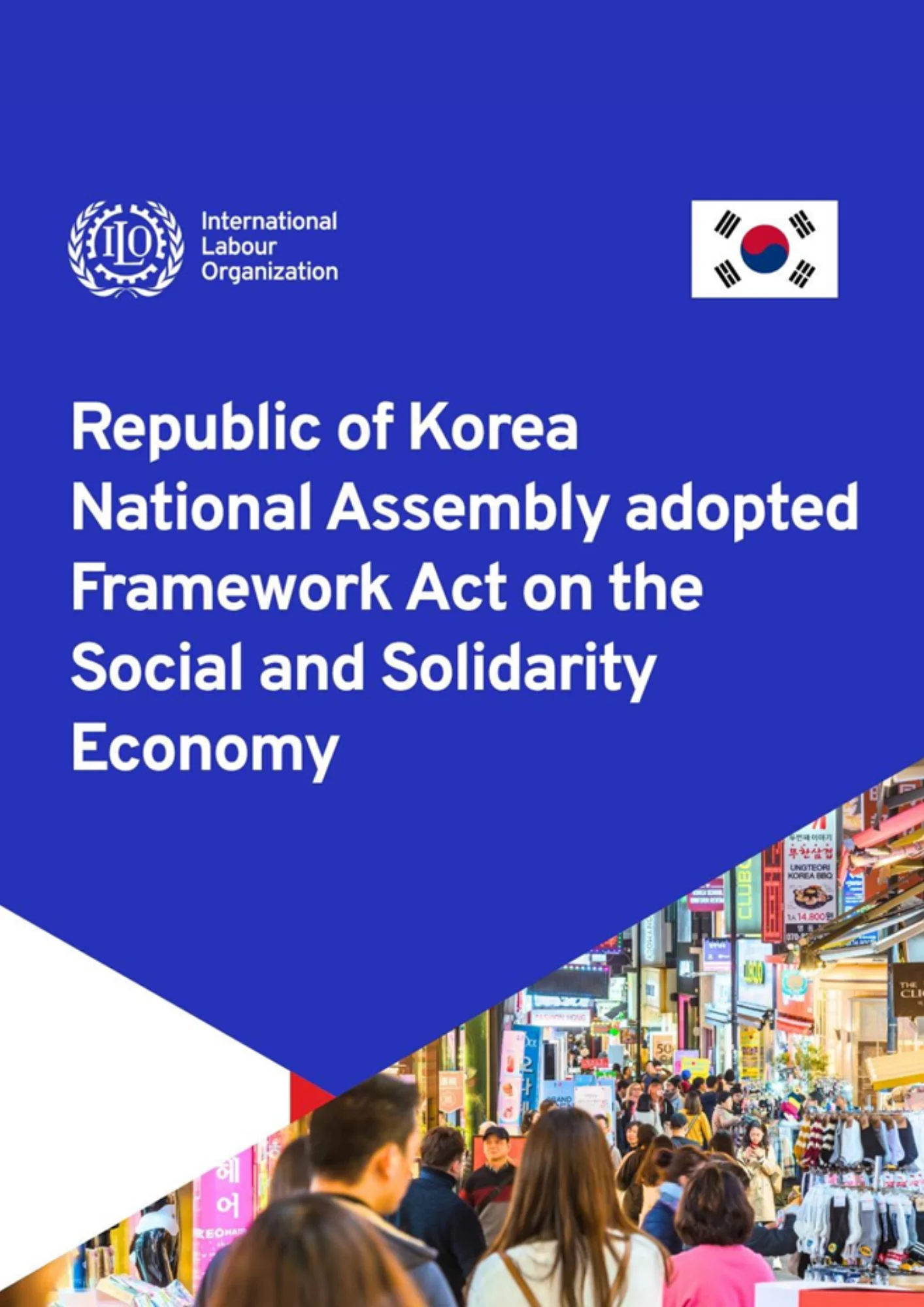
South Korea’s National Assembly adopted the Framework Act on the Social and Solidarity Economy (SSE) on August 20, 2026, marking the first comprehensive legislation of its kind in the Asia-Pacific region
According to Seoul Economic Daily[1], the “South Korean government is launching a full-scale effort to foster social and solidarity economy organizations, including social enterprises and cooperatives. The plan calls for enacting a Framework Act on the Social and Solidarity Economy to codify support measures and an implementation system across ministries, while expanding financial, tax and sales channel support to establish a foundation for sustainable growth.
The Ministry of the Interior and Safety announced the cross-ministerial “Comprehensive Plan for Social and Solidarity Economy Development” at a Cabinet meeting Tuesday. The social and solidarity economy refers to economic activities that pursue social value based on solidarity and cooperation rather than profit maximization, contributing to solving local community problems. The plan was jointly prepared by 20 relevant ministries led by the Interior Ministry beginning in October last year, as part of the Lee Jae-myung administration’s key national agenda of “promoting growth of the social and solidarity economy.”
The government will first significantly increase financial support. It will expand the Korea Inclusive Finance Agency’s microfinance supply from 6 billion won annually to 15 billion won, and increase the Korea Credit Guarantee Fund’s guarantee supply from 200 billion won last year to 350 billion won by 2030. Private finance will also be strengthened. Bank lending will be expanded to 4.3 trillion won by 2028, and the Korean Federation of Community Credit Cooperatives will provide loans of 200 billion won over the next five years. The government will also push to revise the Credit Unions Act to allow individual credit unions to invest in other corporations.
Support will also be strengthened for each stage of startup and growth. A new track will be created for social and solidarity economy startups within three years of founding, providing commercialization funds of up to 1 billion won. Companies with high growth potential will receive a package of incubation and consulting, funding, and sales channel and export support. Social enterprises and social cooperatives that enter into public contracts with local governments will be exempted from the 5% bid bond, and a mandatory public sector purchase system will also be introduced.
In addition, the government will expand the acquisition tax and property tax reductions previously applied to existing social enterprises and cooperative corporations such as Nonghyup to social cooperatives and village enterprises, and will further reduce usage and lease fees for state and public property.
Along with this, the government plans to integrate and manage policies that had been scattered across ministries through enactment of the Framework Act on the Social and Solidarity Economy”.
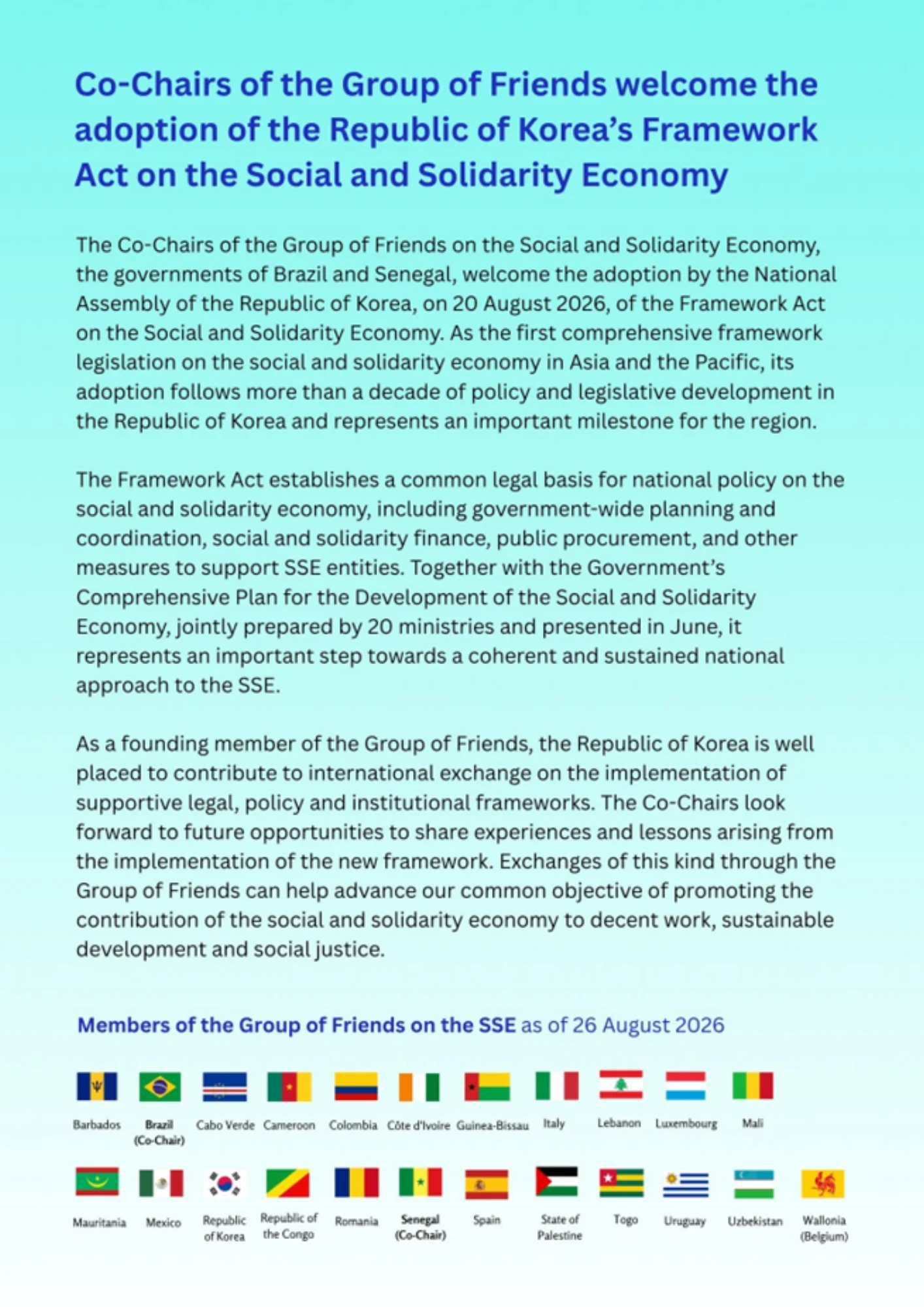
In this context the Group of Friends on the Social and Solidarity Economy welcome the new Korea SSE framework registration
In a statement[2] “the Co-Chairs of the Group of Friends on the Social and Solidarity Economy, the governments of Brazil and Senegal, welcome the adoption by the National Assembly of the Republic of Korea, on 20 August 2026, of the Framework Act on the Social and Solidarity Economy. As the first comprehensive framework legislation on the social and solidarity economy in Asia and the Pacific, its adoption follows more than a decade of policy and legislative development in the Republic of Korea and represents an important milestone for the region.
The Framework Act establishes a common legal basis for national policy on the social and solidarity economy, including government-wide planning and coordination, social and solidarity finance, public procurement, and other measures to support SSE entities. Together with the Government’s Comprehensive Plan for the Development of the Social and Solidarity Economy, jointly prepared by 20 ministries and presented in June, it represents an important step towards a coherent and sustained national approach to the SSE.
As a founding member of the Group of Friends, the Republic of Korea is well placed to contribute to international exchange on the implementation of supportive legal, policy and institutional frameworks. The Co-Chairs look forward to future opportunities to share experiences and lessons arising from the implementation of the new framework. Exchanges of this kind through the Group of Friends can help advance our common objective of promoting the contribution of the social and solidarity economy to decent work, sustainable development and social justice”.
[1] https://en.sedaily.com/society/2026/06/30/korea-to-boost-social-economy-with-new-framework-law
[2]: www.unsse.org/ssegof