
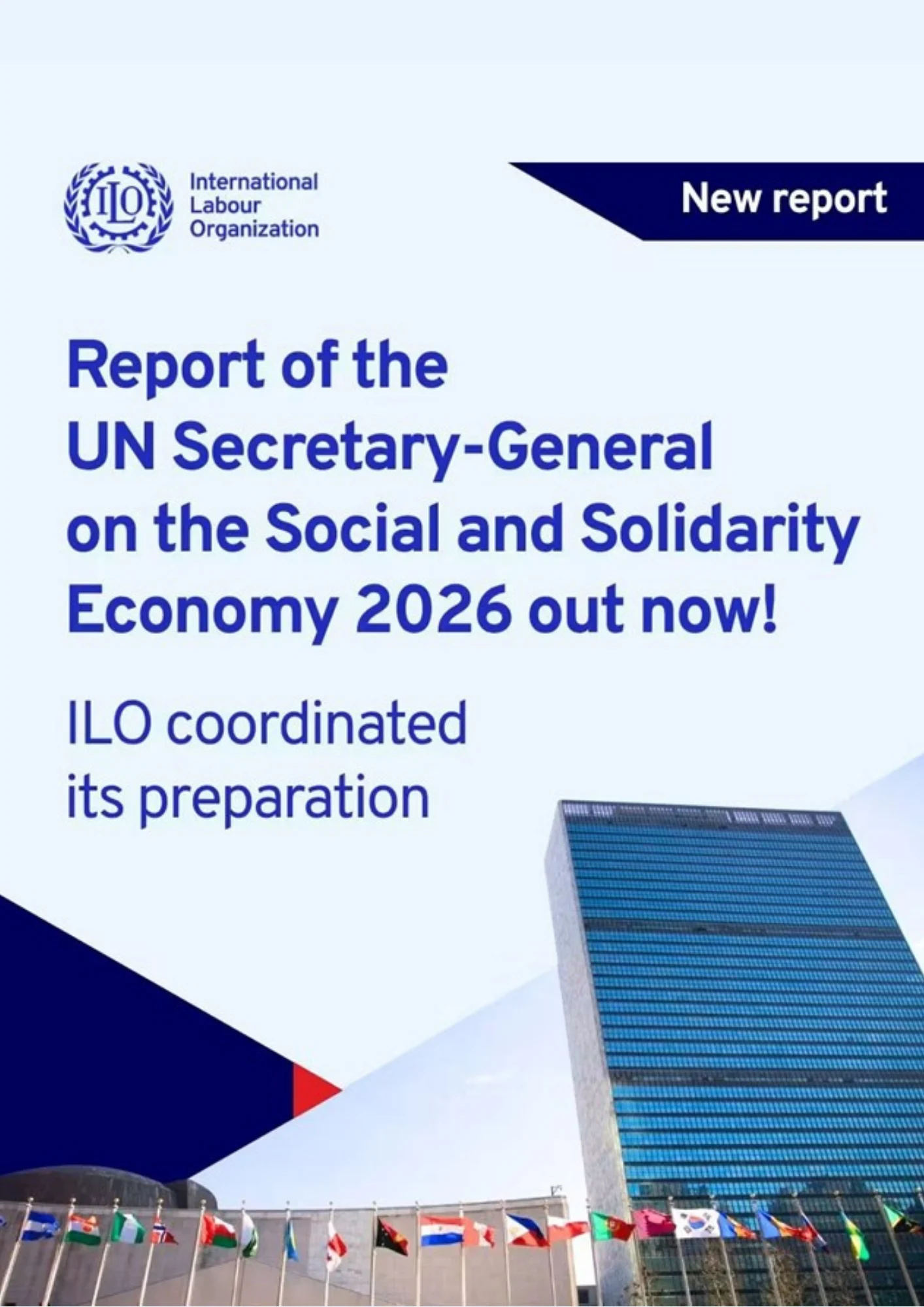
The 2026 Report[1] entitled “Promoting the social and solidarity economy for sustainable development” was recently released. This is the UN Secretary-General second report on the Social and Solidarity Economy which was recently released in pursuant to General Assembly resolution 79/213.
Comparison of the 1st and 2nd SG SSE Reports
The first was presented in 2024[2] was also promoted under the same title “Promoting the social and solidarity economy for sustainable development,”. It was presented in October 2024 during the 79th session of the United Nations General Assembly.
A compare and contrast of both the SC reports will show that while the first focused heavily on defining and recognizing the SSE globally, the 2026 report specifically evaluates implementation progress, concrete national measures, and counter-cyclical contributions during recent global economic and fiscal constraints. These documents by the Secretary General are official United Nations documents reviewing global progress, challenges, and multilateral actions regarding community-based, socially driven economic models.
The 2026 SG Report
The title for the 2026 report is similarly worded like the 2024 report on promoting the Social and Solidarity Economy (SSE) for sustainable development. The report notes that the global efforts are coordinated by the International Labour Organization which facilitated cooperation with different UN agencies and global partners through the UN Inter-Agency Task Force on Social and Solidarity Economy (UNTFSSE).
The report highlights contributions and data from around 40 Member States and UN entities, focusing on areas like inclusive local development, social cohesion, and cooperative business models. The report documents the role played by Member States to support and enhance SSE. Members states saw participation in nine areas such as the:-
- Establishing a conducive environment for SSE
- Strengthening support measures for SSE
- Integrating SSE and its entities into relevant strategies, policies and programmes
- Promoting social innovation consistent with SSE values and principles
- Improving statistics relating to SSE
- Documenting lessons learned from good practices
- Integrating SSE into relevant multilateral processes
- Mainstreaming of SSE in UN development system
- Financial support for SSE
SSE and Human rights
In para 45 of the Report there is a specific linkage between SSE, poverty eradication, the right to food and a human rights economy centred on people, planet and human rights norms and standards. The report highlights the UNTFSSE, the Special Rapporteur on extreme poverty and human rights and the Global Coalition for Social Justice launched in 2026 a joint policy brief on the contribution of SSE and human rights economy.
Asian Pacific Member States and SSE
The Report acknowledged that in Asia and the Pacific, progress has been driven primarily by national initiatives, while regional institutional arrangements continue to evolve.
There are references on SSE developments in eight Asian countries as highlighted below
In para 30 there is a reference to the Malaysia social innovation policy (2025–2030) which links local needs, technologies and benefits, and provides for the involvement of cooperatives and associations in its implementation.
Reference is made to Japan for implementing the Worker Cooperatives Act, noting that 191 worker’s cooperatives have been established since July 2026.
In the Philippines, the Cooperative Development Authority adopted the Philippine Cooperative Development Plan (2025–2028), following nationwide stakeholder consultations.
On an SSE framework legislation reference is made to the Republic of Korea, having introduced it and remains pending before National Assembly. Subsequently in August 2026, this legislation on SSE has been approved. In the Republic of Korea, purchases from certified social enterprises represented 3% of procurement by relevant public institutions in 2025
The examples from Sri Lanka and India are highlighted in para 25 of the report. In the case of Sri Lanka, a care cooperative development (2025–2030), was launched. This includes a community-based care services being piloted through selected cooperative organizations.
In the case of India, the Mahila Shakthi in Telangana support women’s self-help groups through measures concerning finance, skills, production, marketing and social protection.
The ILO promoted care provisions through SSE in a number of Asian countries namely Cambodia, Nepal and Sri Lanka. Among the initiatives were national assessments, policy dialogue, training, knowledge-sharing and pilot activities.
Role of ILO and the UN Task force on SSE
It is important to note the significant role played by ILO. It co-chairs the UN Inter-Agency Task Force on Social and Solidarity Economy (UNTFSSE) and provides its secretariat, coordinated preparation of the report in collaboration with the members and observers of the Task Force.
The report acknowledged “the contribution of the United Nations Inter-Agency Task Force on Social and Solidarity Economy to system-wide coherence, coordination and knowledge exchange, and encourage its members and observers, in accordance with their respective mandates, to strengthen cooperation through the Task Force”
RIPESS has observer status in the UNTFSSE[3]. ASEC being part of RIPESS therefore part of this UN process.
A public discussion on the UN Secretary General Report on SSE (Sept 25)
In this context the UNTFSSE is hosting a half day discussion[4] with member states and other partners on Sept 25, 2026 in New York city. This is entitled Advancing the Social and Solidarity Economy Discussion of the Report of the United Nations Secretary-General on the Implementation of General Assembly Resolution 79/213 and Ministerial.
[1] https://docs.un.org/en/A/81/288
[2] https://documents.un.org/doc/undoc/gen/n24/266/89/pdf/n2426689.pdf
[3] https://unsse.org/about-3/ and https://unsse.org/observers-2/
[4] https://unsse.org/wp-content/uploads/2026/08/202609-Agenda-Concept-Note-SSE-NY-1.pdf