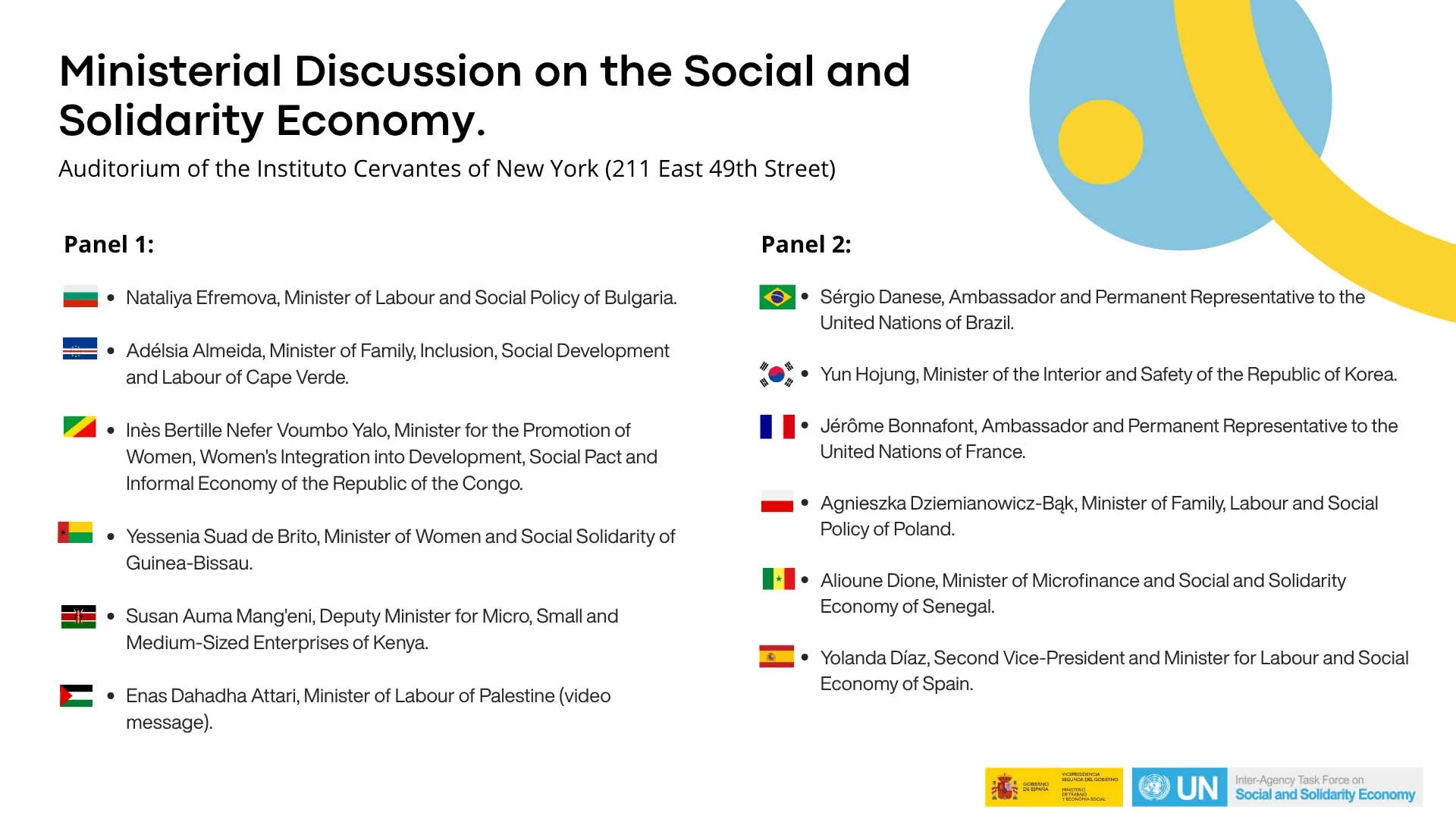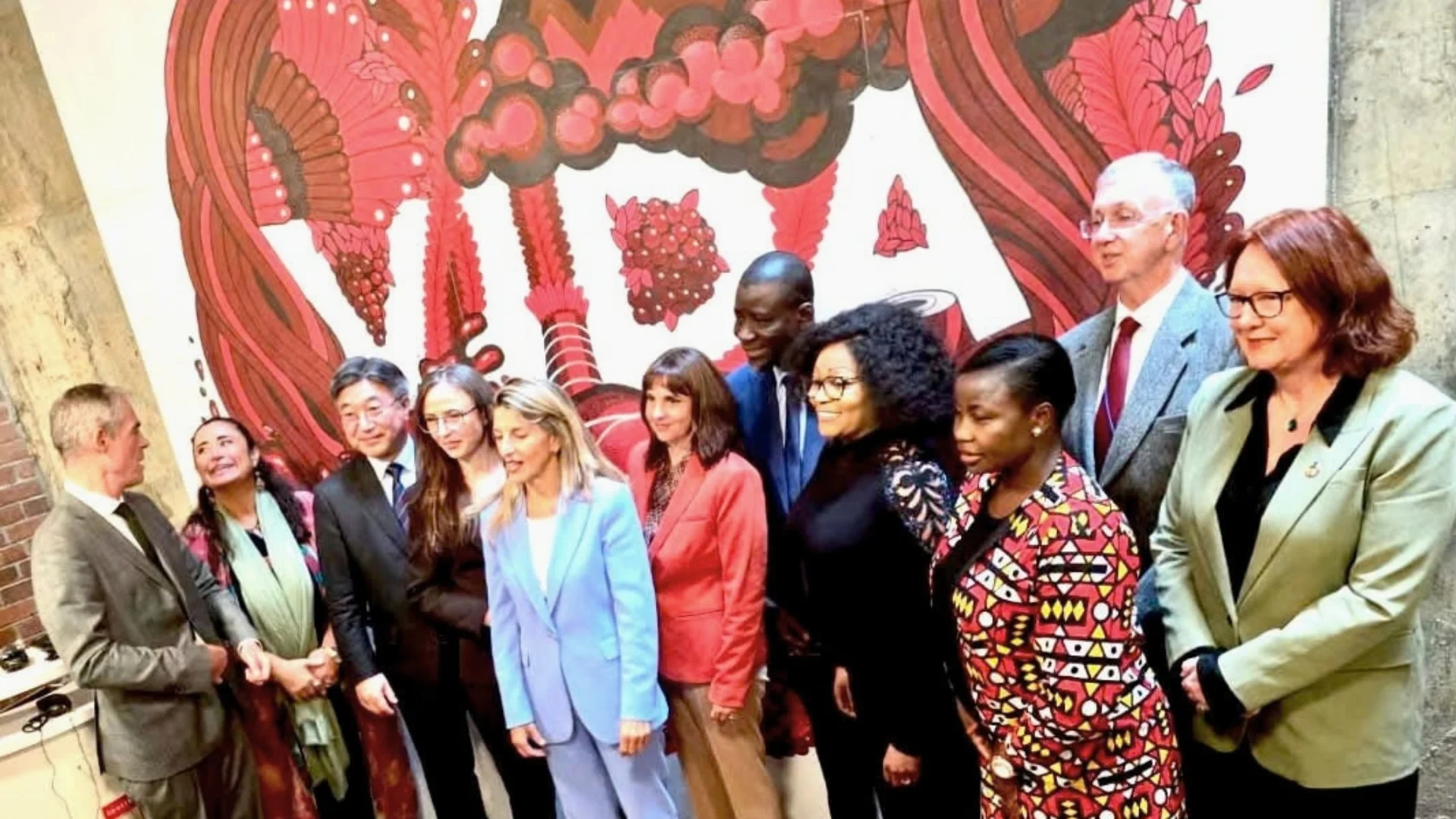
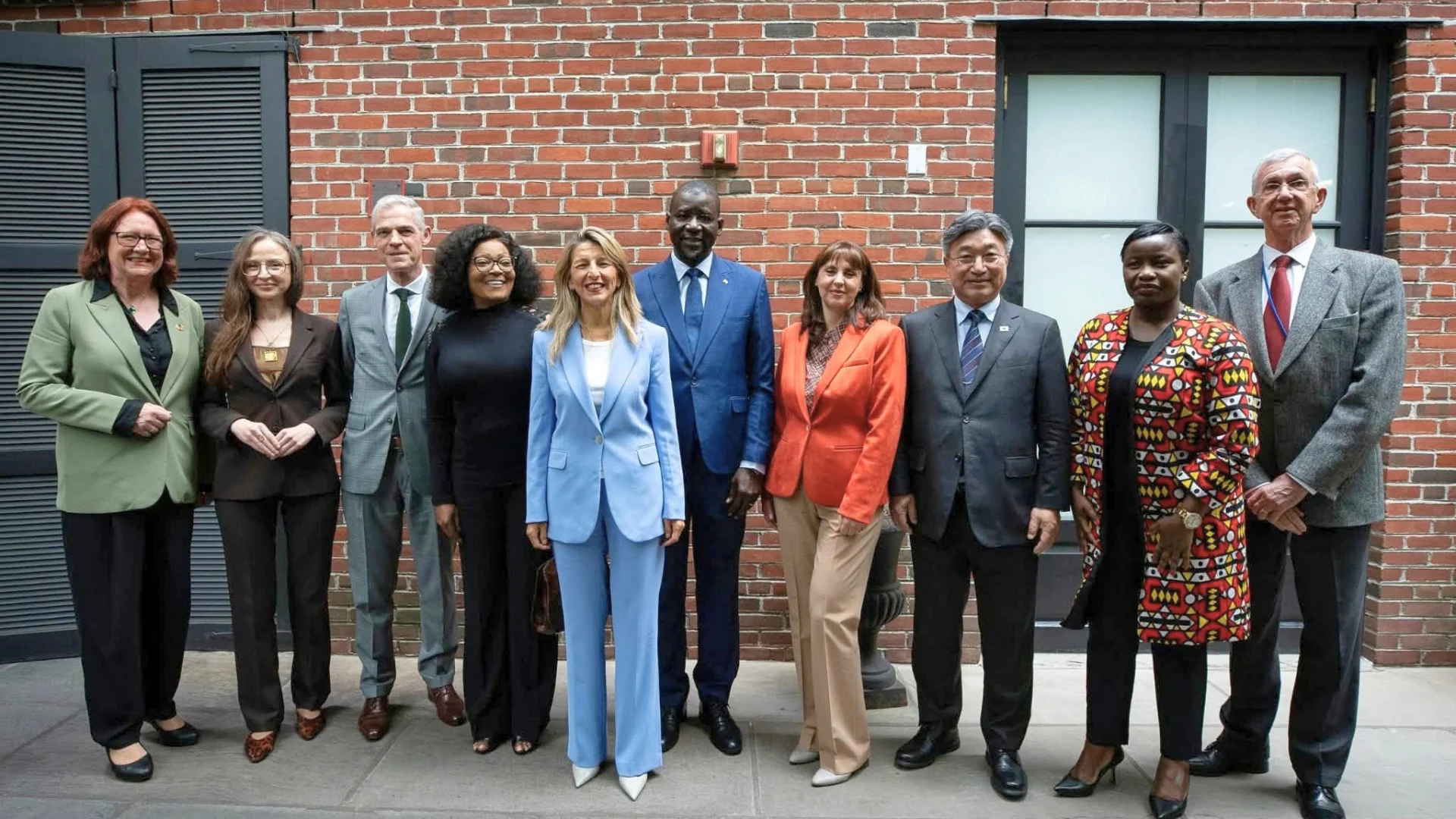
A discussion was held on Sept 25, 2026 at New York hosted by the Ministerial Dialogue of the Group of Friends on SSE and the UN Task Force on SSE (UNTFSSE). Both Spain and Senegal were the led member states hosting the event. Their focus was to discuss the Report of the United Nations Secretary-General on the Implementation of General Assembly Resolution 79/213 on SSE
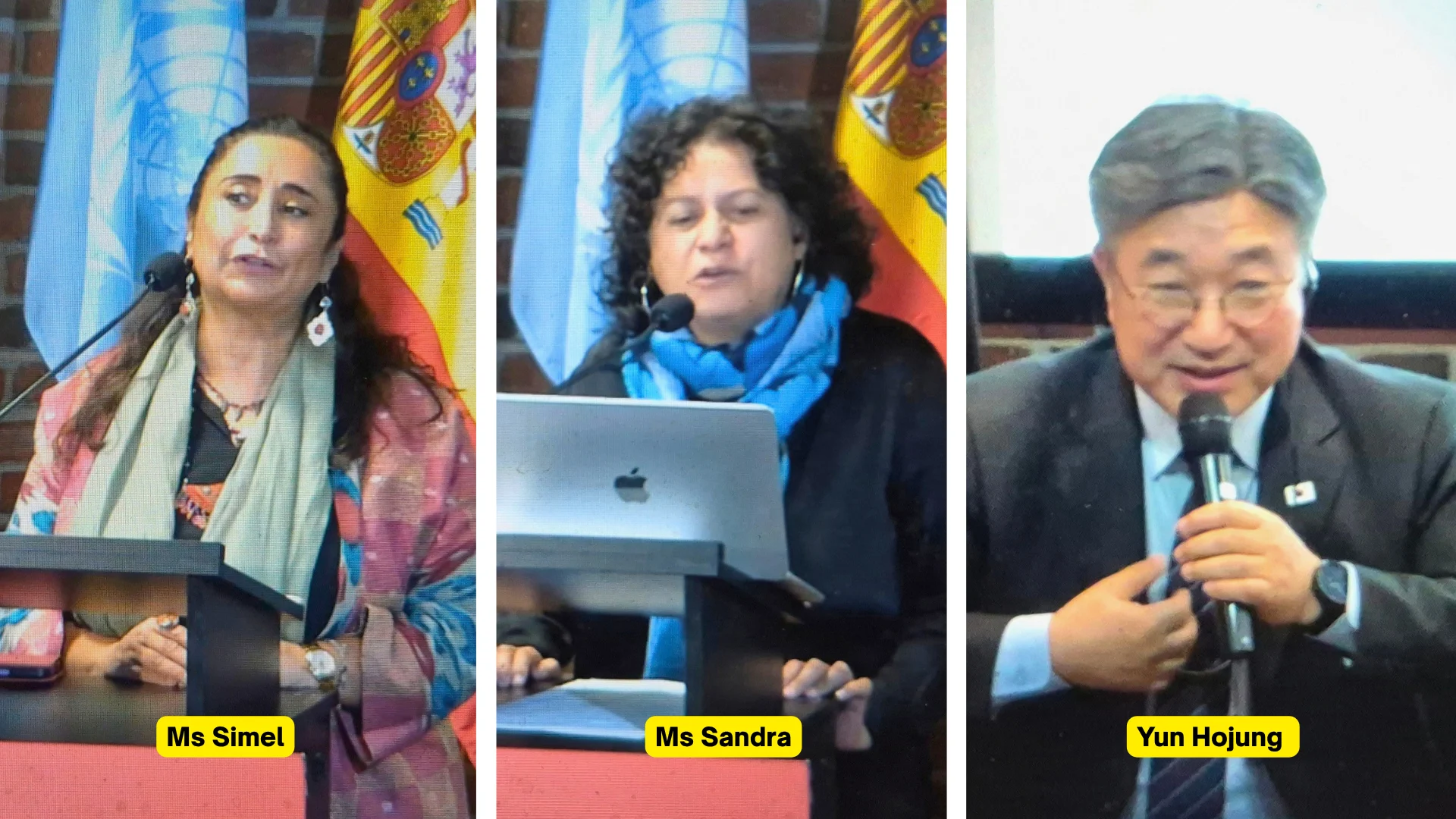
Ms Simel Esim’s Opening address
The discussion was, inaugurated by Ms Simel Esim, who is head of the SSE Unit in the ILO and President of the UNTFSSE. In her presentation she said that over the past 15 years there have been positive developments with key milestone achievements such as the setting up of the UNTFSSE and increased interest and support from member states. According to Simel, the ILO resolution in 2022 paved the way for two UN level resolutions on SSE to be passed in 2023 and 2024. She went on to make some specific comments on the Secretary General Report on SSE (July 1, 2024 to 30 June 2026) which is dated 29 July 2026. On this report we already have an article in ASSEC website[1].
Drawing from the UNSG report (2026), the findings highlight “that the social and solidarity economy received greater legal, policy and institutional attention, accompanied by advances in statistical work. Progress nevertheless remained uneven, with stronger evidence of formal action than of effective implementation and sustained results. The report concludes with recommendations to strengthen implementation, support measures, participation and efforts to measure the social and solidarity economy”.[2]
Based on the UNSG 2026 report, Ms Esim drew attention to increased member state participation in SSE related activities at the national level such as recognition, registration, governance, supervision, representation participation and coordination. The principles of SSE are inbuilt in international definition of SSE especially in terms of democratic control, membership and rules governing distribution and use of surplus and asserts including worker ownership. There is the increased social dialogue and social innovation approaches adopted by member states. At the global level there is increased cooperation among member states as illustrated by such movements as Friends as SSE as well in South-South cooperation. These are seen as positive developments.
SSE Speakers and Member state representatives
Ms Simel invited two SSE leaders to share their view on the UNSG SSE report. The first was Mr Michael Peck (co-founder and executive director of the 1worker1vote movement) and the second was Ms Sandra M Cadena (RIPESS).
After these two interventions 13-member state speakers shared their nation experiences. Representatives from Brazil, Bulgaria, Cape Verde, Cote d’lvoire, Spain, France, Guinea-Bissau, Kenya, Palestine, Poland, Senegal, Congo, Korea and Uruguay. In this article we highlight the concerns raised by RIPESS speaker and also the Korean representative on their recent SSE Act. The full recording of the video is enclosed entitled: Discussion on the UN Secretary-General’s Report on Resolution 79/213 regarding the Social and Sol…
Intervention by RIPESS – Ms Sandra Moreno Cadena
At this discussion Ms Sandra of RIPESS was one of the two SSE speakers. In her intervention she said that this was a timely dialogue and that RIPESS welcomes the 2026 Secretary-General’s report. She affirmed that RIPESS was glad to have contributed to this process.
She went to say “Social and solidarity economy is increasingly recognized in legal, policy and institutional frameworks as a pathway towards sustainable development, decent work and social justice. The report also makes clear that recognition is moving faster than implementation. The question before us is therefore not only whether the SSEF is visible in policy. It is whether political recognition changes the conditions of life, work and collective power of the communities who build and benefit the SSEF every day.
RIPESS had directly supported and helped the implementation of resolution 79/213 through the Financing for Development process and the Sevilla Commitment outcome that explicitly recognized SSE, cooperatives and the need for tailored financial and non-financial support. This gives us, for the first time, a global normative basis to build dedicated SSE financing windows, guarantees, public-development-bank strategies and solidarity-finance mechanisms. RIPESS calls on Member States and financial institutions to turn this recognition into operational tools and financing that reaches organized territories, women, youth, informal workers, small producers and marginalized communities
We are here in NY also to place SSE at the center of climate justice in different events. The Green Climate Fund has opened the way while proposing a specific and adapted financing framework under its Locally-Led Climate Action window. We need to apply together, replicate this model into other UN thematic tracks ! This is how we would prove our ability to deliver on SDGs, the Climate and Financing for Development Agendas. Because we need to place SSEF at the center of climate implementation. This is also a human-rights agenda. Implementation must strengthen decent work, food sovereignty, care, housing, land and water rights, equality, democratic participation, rights of peasants and rights of indigenous people. It must protect civic space and the autonomy of movements, particularly at a time of authoritarianism, conflict and rising inequality.
We need and we want to work with each one of the National Governments here represented. It is time for us to join forces, means, strategies, and further, faster and stronger than in the past decade. The moment is now. ‘Together we stand, divided we fall’”
Korean Framework Act on SSE
In the panel was the Korean Minister, His Excellency Yun Hojung who highlighted the Korean initiative – The Framework Act on SSE which was adopted by Korea on August 20, 2026. This news was highlighted in our website previously.[3] Soth Korea is the first Asian country to have a specific act on SSE. Enclosed is an unofficial English version. This is new and is made available for our reading and study on a legislative framework for SSE adopted in Korea.
[1] https://assec.com.my/the-2026-report-of-the-un-secretary-general-on-the-social-and-solidarity-economy/
[2] https://assec.com.my/wp-content/uploads/2026/08/UN-SG-SSE-Report-2026.pdf (page 1)